Acrosser Announced New Apollo Lake Network Appliances: AND-APL1N1FL

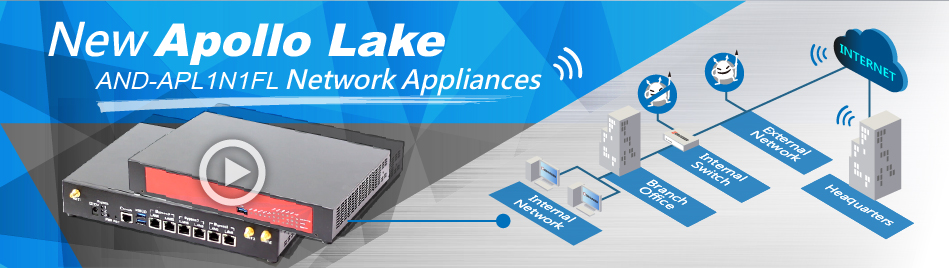
In order to provide customer more choices in entry-level network solution, today acrosser Technology, a world-leading network appliance supplier, proudly revealed its latest micro box fan-less network appliance –AND-APL1N1FL series.

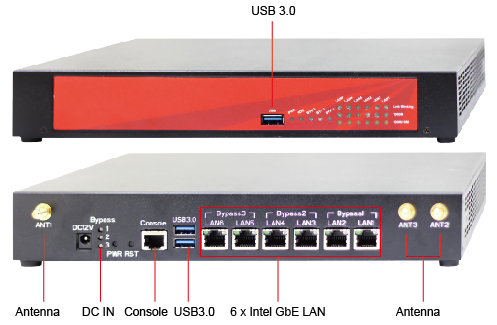
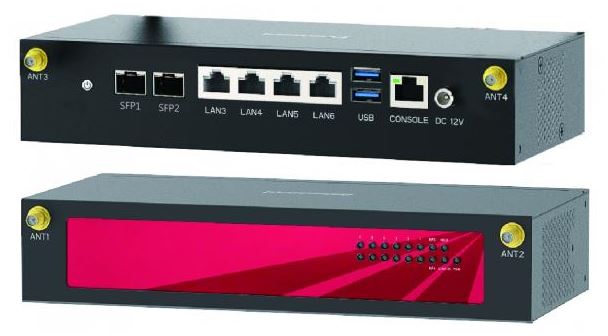
The fan-less micro box network appliance, AND-APL1N1FL, can offer the UTMost connectivity with a compact form factor at dimensions 280 x 209 x 44 mm (11.02” x 8.23” x 1.73”). In addition, AND-APL1N1FL also supports 3-pair LAN bypass for Ethernet connection and provides a luxurious set of I/O, including one mini PCIe slot to support WiFi or 4G, three USB3.0 ports on the rear panel, one console port (RJ45), 8-bit GPIO on-board pin header, and one SATA III port or mSATA socket. Rich I/O ports and drive bays are designed for easy access and maintenance.

AND-APL1N1FL, with compact size and reasonable cost, is the perfect solution for small office network solution, UTM, mail server and firewall applications.
AND-APL1N1FL Specifications:

  1. Intel® Apollo Lake SoC J-series/N-series/E-series
  2. 1 x SO-DIMM DDR3L-1866 MHz, up to 8GB
  3. 6 x GbE, 3 x USB
  4. 1 x Mini PCIe Socket
  5. 8 x GPIO

Product introduction video please refers to:

https://www.youtube.com/watch?v=1JymTQfSXsY&feature=youtu.be

This new Apollo Lake network appliance: AND-APL1N1FL is designed with customers looking for a cost-effective niche solution in mind. Samples are available upon request; please contact us via the online inquiry system:

http://www.acrosser.com/inquiry.html

Subscribe to our social media sites and stay connected!

Please visit us @ the following social media sites:

Acrosser Facebook

Acrosser Twitter
Acrosser Youtube

Network Application, COM Express, car pc, Embedded pc, Embedded board,
Acrosser is able to directly obtain valuable resources in providing high quality and stable performance products/solutions to its customers, vis-à-vis non-IoT-Alliance-members.

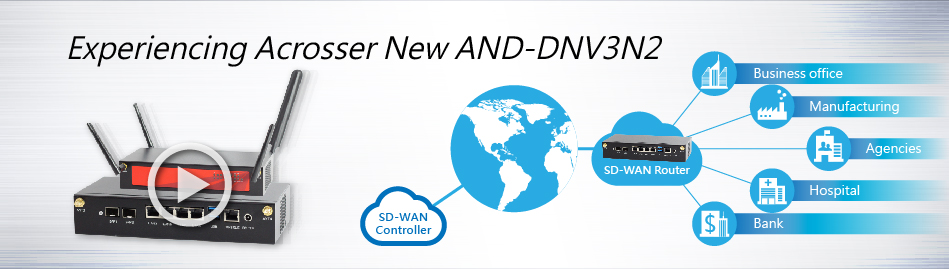
acrosser Technology latest network applianceAND-DNV3N2, which equipped with Intel® Atom C3558 Denverton-NS Platform and 2x SO-DIMM DDR4, 6x GbE, 2x USB 3.0, 2x Mini PCIe(One support SIM card socket),1x 2.5″ SSD and TPM 2.0 for a secure cryptoprocessor. This optimized system design allows network systems to function in a small footprint and form factor. In this particular size, the AND-DNV3N2 is a great alternative for the budget-conscious buyers. This cost-effective network security appliance can offer stable performance with low power consumption; and is suitable in multiple security applications including: network intrusion prevention, content filtering, data leak prevention, VPN, unified threat management (UTM) and SD-WAN solutions.

Major AND-DNV3N2 Specification:
1.Intel® Atom C3558 Denverton-NS Platform
2. 4-Core SoC
3. 2x SO-DIMM DDR4
4. 6x GbE, 2x USB 3.0
5. 2x Mini PCIe, One support SIM card socket
6. 1x 2.5″ SSD,
7. TPM 2.0

AND-DNV3N2  product vidoe ==> Here

Acrosser had committed its valuable resources to further develop its advanced network product lines. Furthermore, Acrosser is now working directly with Intel, as part of Intel IoT Solutions Alliance, in order to be able to offer its customers first-to-market services, the latest technologies, and solutions in a timely manner. As a member of Intel IoT Solutions Alliance, Acrosser is able to directly obtain valuable resources in providing high quality and stable performance products/solutions to its customers, vis-à-vis non-IoT-Alliance-members.

For pricing and availability, please send your inquiry at http://www.acrosser.com/inquiry.html

Subscribe to our social media sites and stay connected!
Please visit us @ the following social media:

Acrosser Facebook

Acrosser Twitter

Acrosser Google+

Acrosser Youtube

Fanless embedded system, mini itx board, Network Server Hardware,

PC 104 single board computer, car pc,

Acrosser is able to directly obtain valuable resources in providing high quality and stable performance products/solutions to its customers, vis-à-vis non-IoT-Alliance-members.

acrosser Technology latest network applianceAND-DNV3N2, which equipped with Intel® Atom C3558 Denverton-NS Platform and 2x SO-DIMM DDR4, 6x GbE, 2x USB 3.0, 2x Mini PCIe(One support SIM card socket),1x 2.5″ SSD and TPM 2.0 for a secure cryptoprocessor. This optimized system design allows network systems to function in a small footprint and form factor. In this particular size, the AND-DNV3N2 is a great alternative for the budget-conscious buyers. This cost-effective network security appliance can offer stable performance with low power consumption; and is suitable in multiple security applications including: network intrusion prevention, content filtering, data leak prevention, VPN, unified threat management (UTM) and SD-WAN solutions.

Major AND-DNV3N2 Specification:
1.Intel® Atom C3558 Denverton-NS Platform
2. 4-Core SoC
3. 2x SO-DIMM DDR4
4. 6x GbE, 2x USB 3.0
5. 2x Mini PCIe, One support SIM card socket
6. 1x 2.5″ SSD,
7. TPM 2.0

AND-DNV3N2  product vidoe ==> Here

Acrosser had committed its valuable resources to further develop its advanced network product lines. Furthermore, Acrosser is now working directly with Intel, as part of Intel IoT Solutions Alliance, in order to be able to offer its customers first-to-market services, the latest technologies, and solutions in a timely manner. As a member of Intel IoT Solutions Alliance, Acrosser is able to directly obtain valuable resources in providing high quality and stable performance products/solutions to its customers, vis-à-vis non-IoT-Alliance-members.

For pricing and availability, please send your inquiry at http://www.acrosser.com/inquiry.html

Subscribe to our social media sites and stay connected!
Please visit us @ the following social media:

Acrosser Facebook

Acrosser Twitter

Acrosser Google+

Acrosser Youtube

Network Application, COM Express, car pc, Embedded pc, Embedded board,
For the very first time, Acrosser offers all customers a real bargain at the very low price

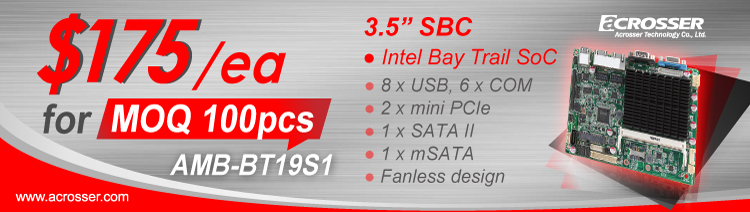
Today, acrosser Technology announces a spring sale to all customers. In this special promotion, Acrosser offers a cost-effective 3.5” embedded CPU board, AMB-BT19S1, at US$175 only for MOQ 100pcs.

AMB-BT19S1, an embedded CPU board at 3.5” form factor, is compact but come with rich I/O ports for high flexibility and easy expansion capabilities.  Built-in Intel low power Bay Trail CPU, it could run in applications that demand reliable operation, consistent performance, and high quality in a harsh industrial environment. In other words, it is suitable for all sorts of industries like factory automation, medical instrument, digital signage, Kiosk, public information station, ATM, M to M, IoT Application and entertainment equipment.

For the very first time, Acrosser offers all customers a real bargain at the very low price, however, the VIP service as well.  You get to enjoy the low price, performance, quality and VIP service all at the same time.  It’s time to jump on the bandwagon and take the advantage!!!

Customers from the US, Canada or Latin America, please call our toll free number +1-886-401-6463 or send your inquiry through our online inquiry system: http://www.acrosser.com/inquiry.html

Customers from other areas, please send your inquiry through our online inquiry system: http://www.acrosser.com/inquiry.html

Features
● Intel Bay Trail SoC, low power consumption.
● 3.5” form factor
● 1 x DDR3L-1333MHz, SO-DIMM, up to 8GB
● 8 x USB port (2 x USB 3.0, 6 x USB 2.0), 6 x COM
● 2 x GbE LAN, 2 x mini PCIe, 1 x SIM slot
● 1 x SATA II, 1 x mSATA
● Dual Display port -VGA & LVDS
● 12V Input
● Fanless design

Acrosser Facebook
Acrosser Twitter

Acrosser Google+

Acrosser Youtube
Acrosser Linkedin

Fanless embedded computer, ITX board, Network Security Hardware,

PC/104, bus pc,


Source licensing for embedded products

The use of each type of open source license in an embedded product design imposes a unique set of obligations on the development team that is incorporating this software into their products. Because of this, some embedded computer maintain a list of open source licenses approved for use by their developers. Other companies go further, explicitly listing which specific version of each open source package has been approved for possible incorporation into the company’s embedded computer  products.

Ensuring that the development team is aware of – and in compliance with – the obligations associated with each of these open source licenses takes time and effort. Tools that can help to identify and track the underlying licenses that apply and enable license obligations to be met can prove quite valuable when trying to hit aggressive solutions  from product development milestones.

refer to: http://embedded-computing.com/articles/the-not-code-quality/

Industrial pc and embedded computer

In all, inevitably, the embedded computer types of processors that will succeed in the future will be the SoCs that provide hardware-accelerated functions. It’s the only way that applications will be able to meet their performance-power budgets. In other words, with homogeneous SMP devices, the embedded computer performance gained by increased core count is not scalable. For example, the more cores that share a common bus structure, the more that each core must compete for memory bandwidth. This problem can be alleviated by designing chips that divide cores into clusters, where each cluster can operate autonomously if necessary.

What plans does the EEMBC have to expand its offerings in the future, and how can the industry get involved?

refer to: http://embedded-computing.com/articles/moving-qa-markus-levy-founder-president-eembc/


The attachment between embedded computers and Intel processor

The 4th generation Intel® Core™ processors serve the embedded computing space with a new microarchitecture which Kontron will implement on a broad range of embedded computing platforms.  Beside a 15% increased CPU performance especially the graphics has improved by its doubled performance in comparison to solutions based on the previous generation processors. At the same  embedded computing , the thermal footprint has remained practically the same or has even shrunk.

Based on the 22 nm Intel® 3D processor technology already used in the predecessor generation, the processors, formerly codenamed ‘Haswell’, have experienced a performance increase which will doubtlessly benefit applications.

With improved processing and graphics performance as well as energy efficiency and broad scalability, the 4th generation Intel® Core™ processors with its new microarchitecture provide an attractive solution for a broad array of mid-range to high-end embedded applications in target markets such as medical,  embedded computing, industrial automation, infotainment and military.

refer to: http://embedded-computing.com/white-papers/white-intelr-coretm-processors/

Future blueprint for medical embedded SBC


“If it is a mobile application with low to single board computer performance requirements, then Qseven is the right choice,” says Christian Eder, Marketing Manager at congatec AG headquartered in Deggendorf, Germany (www.congatec.com). “Medical systems typically require special functionalities such as ultrasonic control or high levels of isolation in order to protect patients in case of a malfunction. Standard SBCs typically do not feature that. The logical consequence is to create a custom carrier board that takes all specific functionalities and complete it with a standard COM. Once single board computer is certified, it is quite easy to upgrade or scale to other CPUs while the certification remains or just needs to be updated. This provides a lot of freedom to choose the best-fitting CPU and graphics for a given application.” This is just one example of why telehealth strategies are poised to revolutionize medicine. Telehealth not only provides quick access to specialists, but can also remotely monitor patients and reduce clinical expenses. Many of the systems needed to realize these benefits will operate on the edge, and require technology with the portability and price point of commercial mobile platforms, as well as the flexibility to perform multiple functions securely and in real time. All of this must be provided in a package that can meet the rigors of certification and scale over long lifecycle deployments.

refer to: http://smallformfactors.com/articles/qseven-coms-healthcare-mobile/

DRAM failure prevention from solution support

An analysis of the failure modes of DRAM in memory embedded modules has determined that DRAM components with suboptimal reliability tend to fail during the first three months of use. As newer DRAMs advance to smaller process geometries, there can be a greater risk for chips that contain weak bits (a microscopic defect in an individual cell). This is not enough to cause a DRAM failure outright, but could exhibit a single-bit error within weeks after initial field operation begins. Using Test During Burn-In (TDBI) helps eliminate any potential early failures and improve the overall reliability of memory products. Although most DRAM chips undergo a static burn-in at the chip level, TDBI offers a more comprehensive testing approach that implements a 24-hour burn-in test at the module level while dynamically running and checking test patterns as the module is performing under stress conditions. Studies conducted by various memory embedded manufacturers show that using TDBI chambers can reduce early failures by up to 90 percent.

refer to: http://embedded-computing.com/articles/ruggedization-memory-module-design/

What about cloud computing and clots?

In vehicle computer, single board computer, Industrial PC


However, once the first bank became a victim, immediately all the other institutions started to learn more about the attacks, search for solutions, then deploy those solutions quickly. When I look at military cloud security solutions, there are many vendors and partners providing tools and solutions, but not many providing availability security embedded computer attacks are hurting the availability of online services and many antivirus vendors and firewall vendors do not focus on the availability aspect.”  Cloud providers find protecting the shared infrastructure can be challenging because it is an expensive up-front cost, he continues. 


refer to : http://mil-embedded.com/articles/cloud-security-the-dod/